

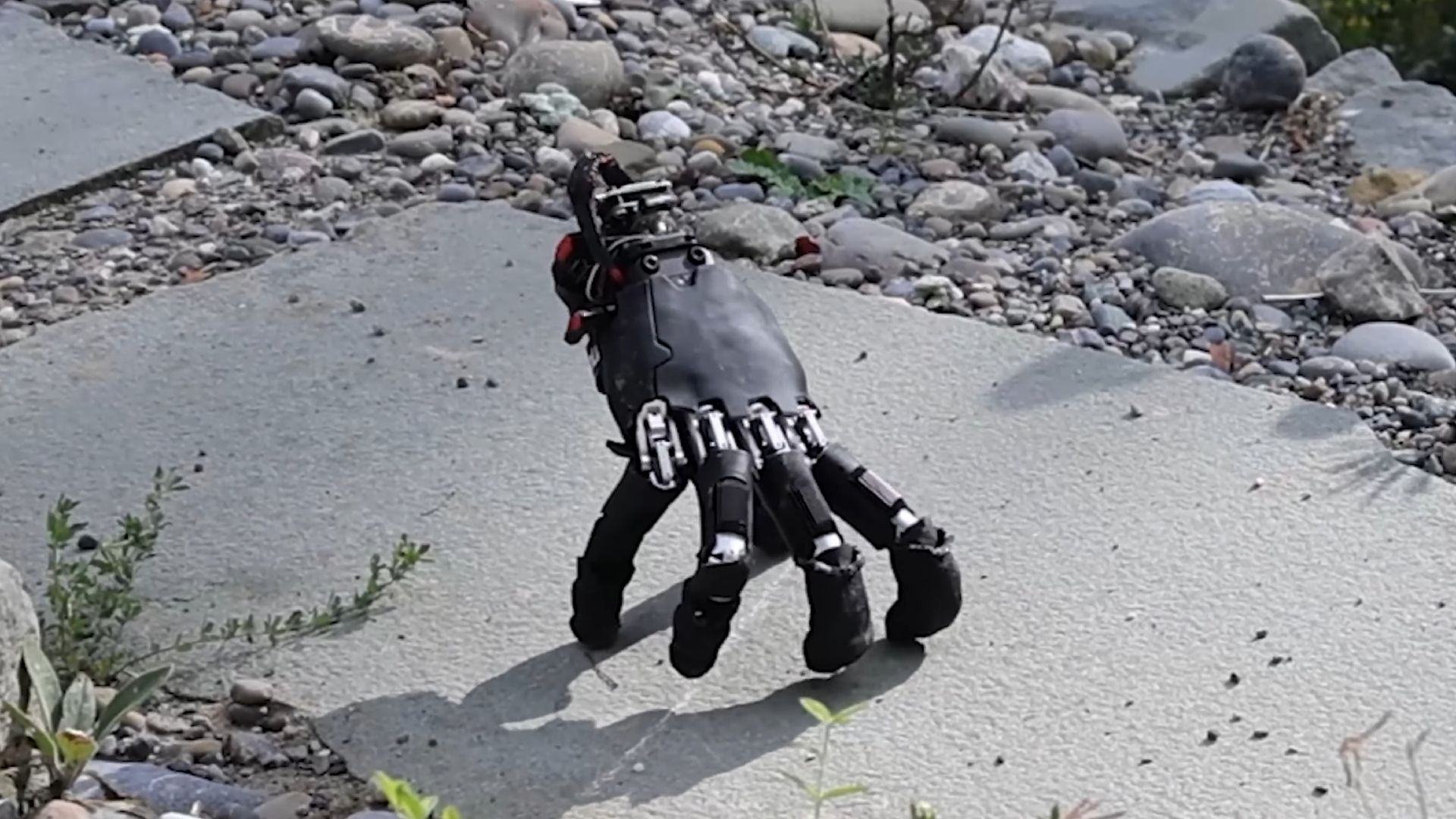
Researchers at ETH Zurich unveiled a disembodied robot hand named Thing that can walk on its own digits. The prototype was presented this week in an online robotics showcase. The team seeks to discover how detached appendages could expand the reach of larger machines.
The prototype features four joints per finger, allowing each digit a high degree of articulation. This mechanical design lets the hand mimic complex motions found in living organisms. The joint count also grants the device flexibility for diverse tasks.
Control of the hand relies on neural‑net‑trained software that iteratively computes joint positions from previous movements. The algorithm was trained inside a simulator via reinforcement learning. This approach enabled the hand to develop a coordinated gait without direct human programming.
During tests the hand displayed a shuffling gait that resembles a spider’s crawl. It can advance forward using its digits as legs, producing a slow but steady motion. The researchers highlighted the gait as a proof of concept for autonomous locomotion.
Beyond locomotion the hand can right itself when tipped over, push small objects, and even press keys on a keyboard. These abilities demonstrate fine‑motor control in addition to walking. The team noted that self‑righting is essential for operation in unstructured environments.
The team envisions the technology helping large robots reach distant points that their bulky frames cannot access. A detached hand could extend a robot’s functional envelope without adding massive structures. Such extensions may benefit inspection, maintenance, and rescue missions.
A video posted on a public platform shows the hand moving, self‑righting, and interacting with a keyboard in real time. The demonstration visualizes the neural‑network decisions as the hand adapts its posture. Viewers can see the practical outcome of the simulation‑based training.